
Public Banking


Exploring how public finance could serve Vermont’s farms, communities, and working lands.
What could Vermont accomplish if more of its public money and credit were directed toward public priorities?
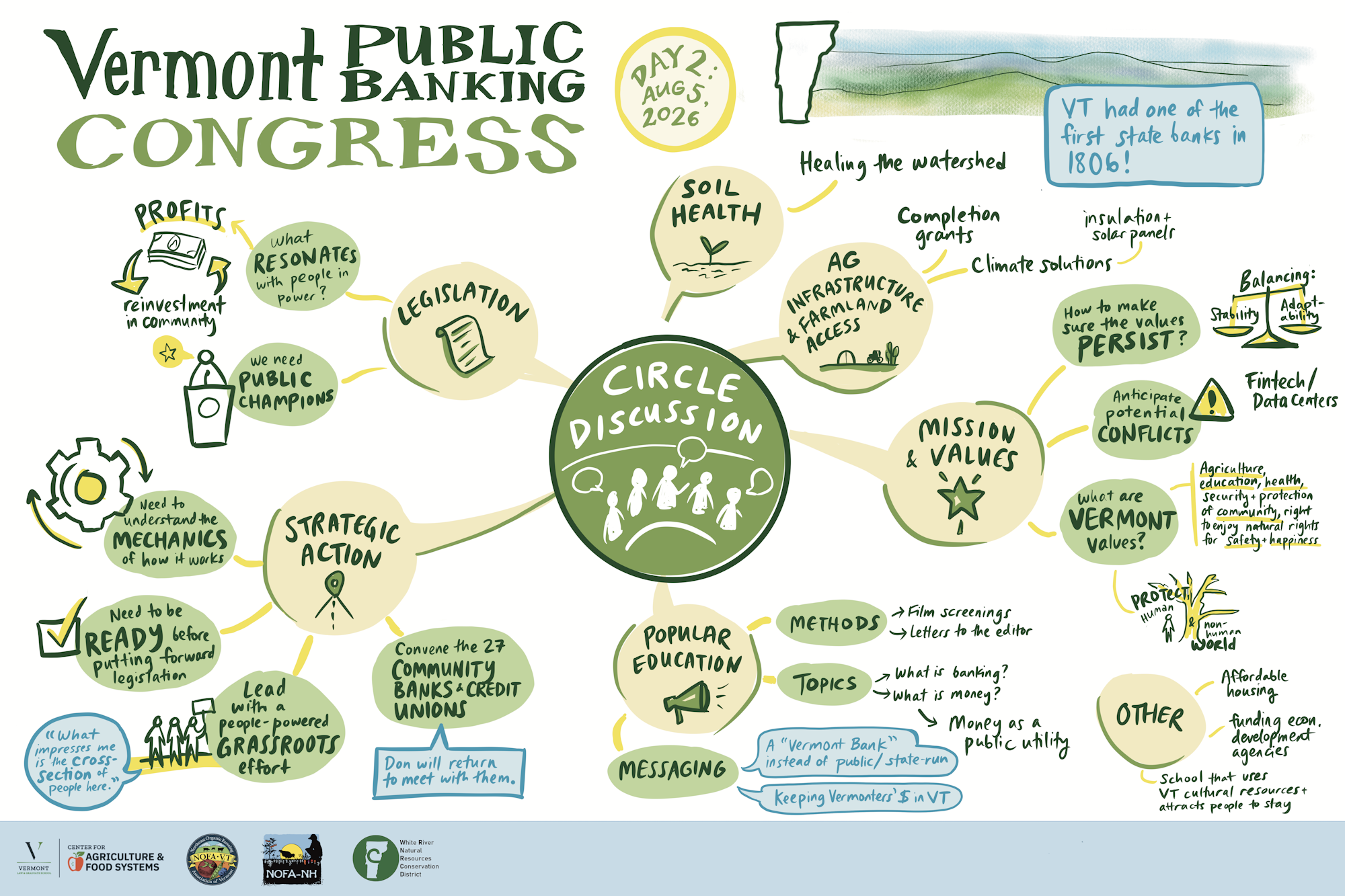
On August 4–5, 2026, White River Natural Resources Conservation District convened the Vermont Public Banking Congress, bringing together farmers, bankers, policymakers, educators, advocates, and community members to explore how public banking works and what it could make possible for Vermont.
The two-day event included an Upper Valley farm resiliency tour, a farmer dinner and discussion, presentations from national public banking leaders, a panel focused on Vermont opportunities, participant-led working sessions, and a closing Congress circle.
Many of Vermont’s conservation challenges are also financing challenges. Farmers need affordable, flexible credit, while communities need patient capital for housing, infrastructure, disaster recovery, and local development. Even when conservation funding is available, farmers are often required to pay project costs upfront and wait for reimbursement—an impossible burden for many operations. Projects that create lasting public benefits therefore may not move forward simply because the necessary capital is not available at the right time or on workable terms.
Conservation Districts were created to help bridge that gap. Following the distribution of the1935 sample Soil Conservation Act, locally governed districts began forming to coordinate technical, financial, and educational resources around locally identified needs. Vermont passed its Soil Conservation Act in 1939 and established its first District in 1940.
Farmers have long led conversations about money and credit—from the farmers’ alliances and Populist movement to the present. Hosting the Vermont Public Banking Congress continues that tradition: bringing people together to explore how Vermont’s financial resources could better serve its farms, working lands, communities, and future.
- Don Morgan, CEO of the Bank of North Dakota
- Christine Desan, Leo Gottlieb Professor of Law, Harvard Law School
- Alphecca Muttardy, Coalition for a National Infrastructure Bank
- Representative Esme Cole, Vermont House of Representatives
- Walt McRee, President, Public Banking Institute
- Julie Davenson, Director, NOFA-NH and Leadership for Ecozoic Fellow, UVM
- Jennifer Byrne, District Manager, White River NRCD
Together, speakers and participants explored how banks create and direct credit, how the Bank of North Dakota partners with community financial institutions, and how public banking could support agriculture, disaster recovery, housing, infrastructure, and rural development.
This page brings together materials from the Vermont Public Banking Congress, including:
Congress AgendaVideo recording of speaker presentations and panel discussions
VT Public Banking Congress 2026 Final Integrated Report & Next Steps- Including:
- Event overview notes
- Farmer discussion findings
- Congress circle reflections
- Emerging opportunities, questions, and possible next steps
These materials are intended to keep the conversation accessible and help Vermonters continue examining a central question: If Vermont had a public bank, what should it make possible?
2026 VT Public Banking Congress with Don Morgan, CEO, Bank of North Dakota


